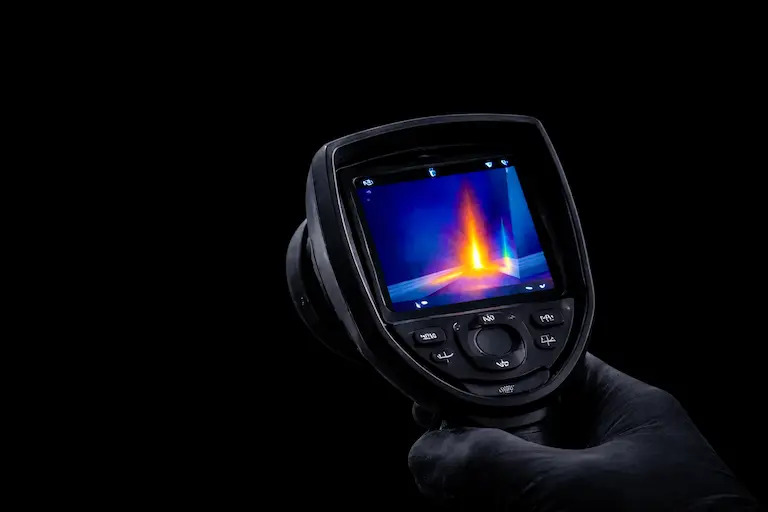
Thermal imaging is particularly useful when there are signs of a hidden leak but the source is not immediately visible.
- Warm water pipe leaks in walls, floors, or ceilings
- Underfloor heating investigations
- Moisture patterns affecting ceilings or internal finishes
- Areas showing unusual thermal contrast or unexplained temperature variation
- Initial non-invasive assessment before more targeted testing
- Situations where access is limited and unnecessary disruption should be avoided
Thermal imaging is carried out by scanning the relevant areas of the property with a professional infrared camera under suitable site conditions. The aim is to identify unusual temperature patterns that may be consistent with concealed moisture, water movement, or heat transfer from hidden pipework.
During the inspection, we assess the reported symptoms, the likely pipe routes, the construction of the property, and whether thermal imaging is likely to provide reliable results. Where temperature differences are present, the camera can help narrow down the area requiring further investigation.
Because thermal imaging is condition-dependent, it is often used as part of a wider leak detection process rather than as a standalone confirmation of the fault. Where needed, we support findings with additional methods to improve confidence in the diagnosis.
- Initial assessment of the property and reported symptoms
- Review of pipe routes, construction type, and likely leak areas
- Infrared scanning of suspect surfaces and affected zones
- Identification of abnormal thermal patterns
- Narrowing down the most likely area of concern
- Recording findings for reporting and next-step recommendations
Where possible, we aim to reduce unnecessary disruption by narrowing down the most likely leak area before any opening up is considered. This helps homeowners, landlords, and property managers move forward with repair work more efficiently and with clearer evidence in hand.
Once testing is complete, we explain the findings clearly so you can understand the likely cause of the issue and the most sensible next step.
- Fixed-price leak detection visit
- Thermal imaging assessment as part of the survey
- Clear explanation of findings on site
- Written report
- Photographic and thermal image evidence where applicable
- Recommendations for repair or further investigation
- Documentation suitable for insurance claims where relevant
Thermal imaging is a safe and non-invasive inspection method. It does not require gas, dyes, or destructive access, and no physical contact with the pipework is needed in order to carry out the survey.
It is suitable for residential and commercial properties where temperature differences can assist with the investigation. As with any diagnostic method, results depend on site conditions, pipe type, water temperature, and the surrounding building materials, so thermal imaging is used where appropriate and interpreted carefully.
Thermal imaging is often chosen because it offers a fast, non-invasive way to assess hidden plumbing issues and temperature anomalies without unnecessary disruption.
It is particularly effective where warm water pipes, heating pipework, or underfloor heating are involved, and where surface temperature changes may help indicate the area of concern. Used correctly, it can help focus the investigation before more intrusive work is considered.
- Non-invasive and efficient
- Useful for concealed hot water and heating pipework
- Can help narrow down the affected area
- Helpful for walls, floors, ceilings, and underfloor heating
- Works well as part of a wider leak detection strategy
We use a combination of specialist leak detection methods, selected based on the system and access available, to support the investigation.Each method is selected based on the specific conditions of the property to ensure accurate results with minimal disruption.